Total population
3,219,375
2023 Census
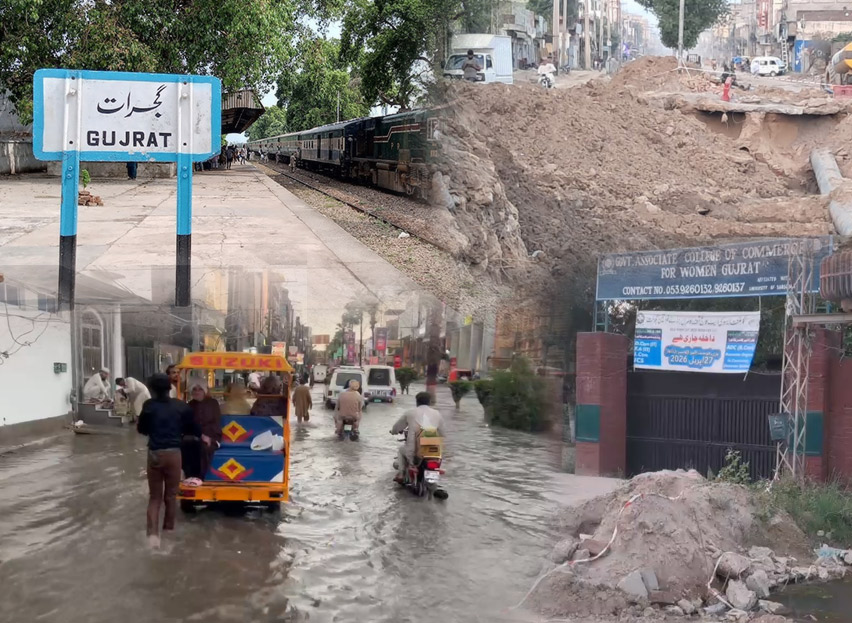
Gujrat District, located in north-central Punjab, Pakistan, is a historically rich, 3,192 km² administrative region known as a key industrial manufacturing powerhouse founded near the Chenab River. Centered around a dense network of over 360 electric fan factories, 137 pottery kilns, and 3 tehsils (Gujrat, Kharian, and Sarai Alamgir), it encompasses 117 Union Councils and 1,082 revenue villages, serving as a core production hub within the country's economic "Golden Triangle" includes Gujranwala, Sialkot and Gujrat industrial cluster.
3,219,375
2023 Census
3,192 sq. km
3 tehsils (Gujrat, Kharian, Sarai Alamgir)
117 union councils
1,082 villages (rural, plus urban MCs)
| Indicator | Value |
|---|---|
| Total population | 3,219,375 (2023 Census) |
| Total area | 3,192 km² |
| Tehsils | 03 — Gujrat, Kharian, Sarai Alamgir |
| Union councils | 117 (post-delimitation) |
| Villages | 1,082 rural (+ urban MCs & corporation sectors) |
| Type | Count |
|---|---|
| Schools (total) | 1,470 |
| Boys schools | 702 |
| Girls schools | 768 |
| Public colleges (total) | 18 |
| Male colleges | 8 |
| Female colleges | 10 |
| Circle | Stations |
|---|---|
| Gujrat City Circle | 04 |
| Gujrat Saddar Circle | 05 |
| Kharian Circle | 06 |
| Lalamusa Circle | 04 |
| Sarai Alamgir Circle | 03 |
| Total | 22 |
Based on listed MNAs and MPAs (NA-62–65, PP-27–29, PP-31–33).
Key percentages cited in the priority issues below (education, employment, water, environment, infrastructure). Health bed capacity is described in the narrative.
| Constituency | Member (party) |
|---|---|
| NA-62 Gujrat-I | MNA Muhammad Ilyas Chaudhary (PTI — Sunni Ittehad Council) |
| NA-63 Gujrat-II | MNA Hussain Elahi (PML-Q) |
| NA-64 Gujrat-III | MNA Chaudhary Salik Hussain (PML-Q) |
| NA-65 Gujrat-IV | MNA Chaudhary Naseer Ahmed Abbas (PML-N) |
| Constituency | Member (party) |
|---|---|
| PP-27 Gujrat-I | MPA Raja Muhammad Aslam Khan (PML-N) |
| PP-28 Gujrat-II | MPA Shahid Raza Kotla (PML-N) |
| PP-29 Gujrat-III | MPA Khalid Asghar Gharal (PML-Q) |
| PP-31 Gujrat-V | MPA Shafi Hussain (PML-Q) |
| PP-32 Gujrat-VI | MPA Syed Madad Ali Shah (PML-N) |
| PP-33 Gujrat-VII | MPA Chaudhry Ijaz Ahmad (PML-N) |
Gujrat faces a structural health capacity deficit of 0.68 beds per 1,000 citizens, channeling the medical burden onto its central urban hub and leaving peripheral zones with an infant mortality rate of 52 deaths per 1,000 live births.
Despite an overall high district literacy rate of 81.37%, a severe primary-to-middle school structural layout gap drives an out-of-school child rate of over 24% across secondary tiers in rural sub-tehsils.
The district carries an 8.9% general unemployment rate, where despite vast influxes of foreign remittances, a 14.5% child labor rate persists within informal suburban cottage industries.
Toxic chemical runoff from heavy manufacturing has severely contaminated shallow aquifers, leaving a legacy municipal drainage grid where 55% of the infrastructure is failing and lacks operational wastewater treatment.
Severe urban-industrial pollution impacts the district as toxic discharge from over 360 electric fan factories and 137 pottery kilns mixes into local ecosystems, while recent agricultural water tests confirm that 16.2% of sub-soil irrigation aquifers have become entirely unfit due to unchecked chemical seepage.
Advanced structural fatigue affects more than 40% of secondary farm-to-market roads, driven by an inadequate infrastructure layout that fails under the weight of overloaded commercial freight trucks transporting industrial goods from manufacturing hubs.