Total population
1,319,909
2023 Census
Hafizabad District, situated in the fertile central plains of Punjab, Pakistan, is a prominent 2,367 km² administrative region bordered on the north and northwest by the Chenab River. Formally established as an independent district in 1991, it serves as an agricultural cornerstone within the Gujrat Division, globally celebrated as a premier rice production hub due to its extensive cultivation of premium Basmati rice varieties.
1,319,909
2023 Census
2,367 sq. km
2 tehsils (Hafizabad, Pindi Bhattian)
46 union councils
422 rural settlements
| Indicator | Value |
|---|---|
| Total population | 1,319,909 (2023 Census) |
| Total area | 2,367 km² |
| Tehsils | 02 — Hafizabad, Pindi Bhattian |
| Union councils | 46 |
| Villages | 422 rural settlements |
| Type | Count |
|---|---|
| Public schools (total) | 734 |
| Boys schools | 344 |
| Girls schools | 390 |
| Public higher education institutions | 10 |
| Circle | Stations |
|---|---|
| Hafizabad Saddar & City Circles | 05 |
| Pindi Bhattian Circle | 04 |
| Total | 09 |
Based on listed MNAs and MPAs (NA-67, PP-37–39).
Key percentages cited in the priority issues below. Health bed capacity is described in the narrative.
| Constituency | Member (party) |
|---|---|
| NA-67 Hafizabad | MNA Aneeqa Mehdi Bhatti (PTI — Sunni Ittehad Council) |
| Constituency | Member (party) |
|---|---|
| PP-37 Hafizabad-I | MPA Shahid Hussain Bhatti (PML-N) |
| PP-38 Hafizabad-II | MPA Zameer Ul Hassan Bhatti (PTI — Independent) |
| PP-39 Hafizabad-III | MPA Muhammad Aoun Jahangir (PML-N) |
Rural farming sub-tehsils manage a severe healthcare bed deficit of 0.58 beds per 1,000 citizens, leaving over 25% of the regional population without immediate access to localized emergency trauma setups.
A sharp post-primary structural layout gap drives an out-of-school children rate of 26.4% across outlying agricultural union councils as teenage students exit classrooms early to join the manual farming sector.
The district carries an estimated 7.8% general unemployment rate alongside a severe shortage of modern technical, IT, and corporate career paths for educated local youth due to highly seasonal rice mill operations.
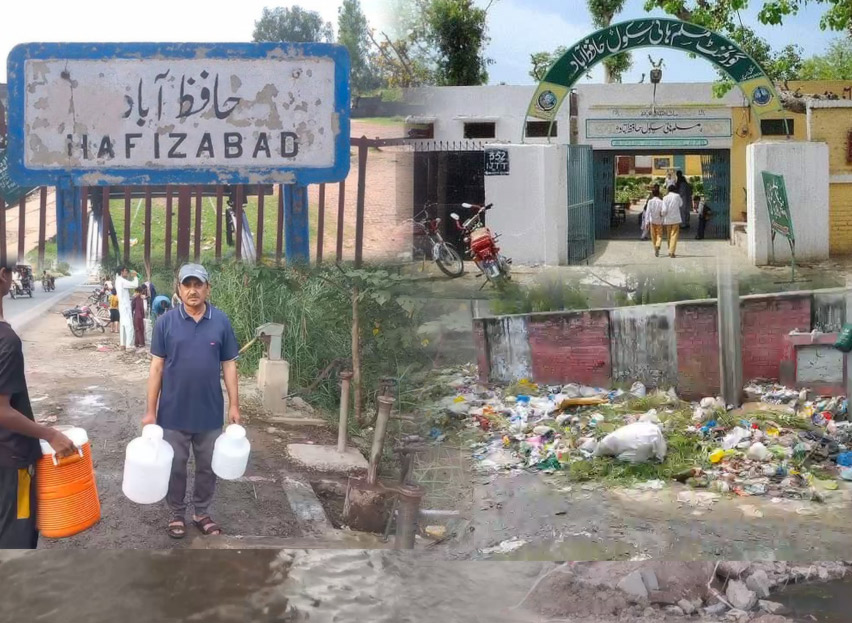
Agricultural chemical runoff and unregulated surface dumping have severely contaminated shallow aquifers, leaving 35% of public water filtration plants completely non-functional.
The unmonitored combustion of rice husks across hundreds of milling chimneys releases hazardous particulate emissions and untreated parboiling wastewater directly into local residential and irrigation networks.
Overloaded commercial freight trucks transporting raw paddy and export rice bags have caused advanced structural layout cracking and severe degradation across 45% of farm-to-market secondary routes.