Total population
993,412
2023 Census
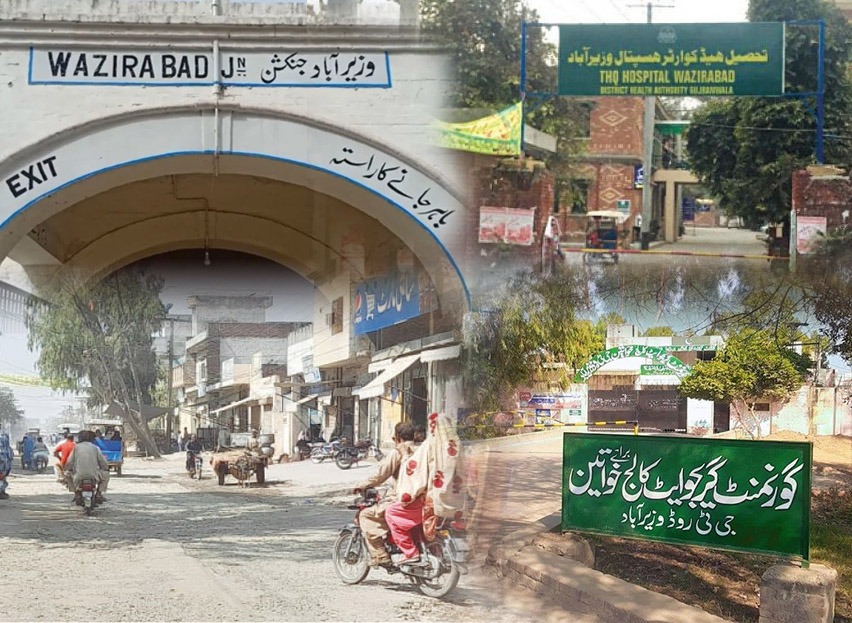
Wazirabad District, located in north central Punjab, Pakistan, is a newly established 1,206 km² administrative region historically celebrated as the global "City of Cutlery". Positioned along the banks of the Chenab River, it functions as a critical industrial link within the Gujrat Division and Punjab's manufacturing "Golden Triangle," globally famous for producing high-grade stainless steel cutlery, kitchenware, and surgical blades.
993,412
2023 Census
1,206 sq. km
3 tehsils (Wazirabad, Ali Pur Chatta, Ghakhar Mandi)
36 union councils
254 rural settlements
| Indicator | Value |
|---|---|
| Total population | 993,412 (2023 Census) |
| Total area | 1,206 km² |
| Tehsils | 03 — Wazirabad, Ali Pur Chatta, Ghakhar Mandi |
| Union councils | 36 |
| Villages | 254 rural settlements |
| Type | Count |
|---|---|
| Schools (public & private registered) | 485 |
| Public higher education institutions | 08 |
| Facility type | Count |
|---|---|
| TB Clinics | 01 |
| THQ Hospitals (Ali Pur Chatta) | 01 |
| Rural Health Centres (RHCs) | 04 |
| Basic Health Units (BHUs) | 28 |
| Rural Dispensaries | 18 |
| MCH Centres | 03 |
| Ch. Pervaiz Elahi Institute of Cardiology | 01 (specialized regional hub) |
| Civil/DHQ Level Referral Hospital Wazirabad | 01 |
| Total facilities | 57 |
| Circle | Stations |
|---|---|
| Wazirabad City Circle | 02 |
| Wazirabad Saddar Circle | 03 |
| Ali Pur Chatta Circle | 03 |
| Total | 08 |
Based on listed MNAs and MPAs (NA-66, PP-35–36).
Key percentages cited in the priority issues below. Health bed capacity is described in the narrative.
| Constituency | Member (party) |
|---|---|
| NA-66 Wazirabad | MNA Muhammad Ahmed Chattha (PTI — Sunni Ittehad Council) |
| Constituency | Member (party) |
|---|---|
| PP-35 Wazirabad-I | MPA Waqar Cheema (PML-N) |
| PP-36 Wazirabad-II | MPA Adnan Afzal Chattha (PTI — Sunni Ittehad Council) |
Wazirabad faces a critical bed footprint deficit of 0.62 beds per 1,000 citizens, leaving over 22% of the rural population without immediate access to basic health facilities.
A sharp post-primary structural bottleneck drives a 22% out-of-school rate as teenage students drop out to join informal industrial sectors.
The district carries an 8.5% general unemployment rate alongside a severe shortage of modern, high-tech corporate careers for university graduates.
Industrial metal-plating effluents have contaminated shallow aquifers, leaving over 40% of public water filtration sources inactive due to maintenance deficits.
The unregulated burning of low-grade fuels across hundreds of cutlery foundry lines releases toxic fumes directly into dense residential quarters.
Overloaded industrial freight trucks carrying raw steel sheets have caused advanced structural cracking across more than 40% of secondary logistics links.